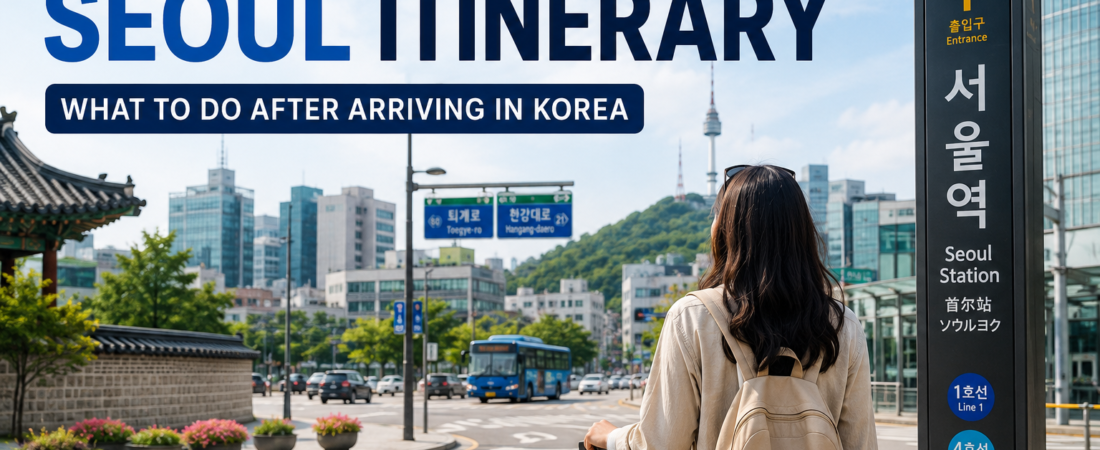
Arriving in Seoul for the first time is exciting, but your first day can also feel a little confusing.
You may be tired from a long flight, carrying luggage, trying to understand airport transportation, and wondering what you should do before your trip really begins. Seoul is a convenient city once you get used to it, but arrival day is not the best time to plan a packed schedule.
A good first day in Seoul should be simple.
Instead of rushing to several famous attractions, focus on getting from the airport to your accommodation, setting up your basic travel tools, eating an easy first meal, and getting familiar with the area around your hotel.
This first-day Seoul itinerary is designed for first-time visitors who want a smooth and realistic start to their Korea trip.
Start at Incheon Airport Without Rushing
Most international travelers arrive at Incheon International Airport. It is clean, organized, and easy to use, but it is still a large airport.
After landing, give yourself enough time for immigration, baggage claim, and transportation. Even if everything goes smoothly, you may still spend more time than expected before you actually leave the airport.
Before going into Seoul, take care of a few basic things.
Make sure your phone has internet access. This may be through an eSIM, SIM card, portable Wi-Fi device, or international roaming. You will need your phone for maps, translation, transportation, hotel directions, and restaurant searches.
It is also helpful to save your hotel address in both English and Korean. If you need to show it to a taxi driver or ask for help, having the Korean address ready can make things easier.
If you plan to use public transportation during your trip, this is also a good time to prepare your transportation card or check where you can buy one.
Get from Incheon Airport to Seoul
Getting from Incheon Airport to Seoul is usually straightforward, but the best option depends on your hotel location, luggage, budget, and arrival time.
For many first-time visitors, there are three main options: airport train, airport limousine bus, or taxi.
The airport train is a good choice if you are staying near Seoul Station, Hongdae, or another area that connects well by subway. It is usually efficient and easy to understand, especially if you are comfortable using trains.
The airport limousine bus is useful if it stops close to your hotel. It can be more comfortable than the subway when you have luggage because you do not need to carry your suitcase through station stairs, transfers, or crowded platforms.
A taxi or private airport transfer can be the easiest option if you arrive late at night, travel with family, have several bags, or feel too tired after a long flight. It costs more, but it may be worth it for a smoother first day.
For arrival day, do not choose transportation only based on price. Choose the option that gets you to your accommodation safely and with the least stress.
Check In or Store Your Luggage
Once you arrive in Seoul, your next goal is simple: get rid of your luggage.
Many hotels in Seoul have afternoon check-in times. If you arrive early, your room may not be ready yet. In most cases, you can ask the hotel to store your bags until check-in time.
This is much easier than carrying your suitcase through busy streets, subway stations, cafes, or restaurants.
If you are staying at a guesthouse, apartment-style accommodation, or smaller property, check their luggage storage policy in advance. Some places may not have a front desk open all day.
After storing your luggage, keep your plan light. Arrival day is not the time to cross the whole city unless you really need to.
Buy or Recharge a Transportation Card
A transportation card is one of the most useful things to have in Korea.
Many visitors use a T-money card, which can be used on subways, buses, and in many convenience stores. You can usually buy or recharge transportation cards at convenience stores and subway stations.
Keep in mind that recharging transportation cards often requires cash, especially at subway station machines. It is a good idea to have some Korean won ready.
On your first day, you do not need to understand every subway line. Just learn the basics: tap in, tap out, check your direction, and look for the correct exit number.
Subway exit numbers are very important in Seoul. When you search for a cafe, restaurant, hotel, or attraction, directions often mention the closest subway exit. Knowing the exit number can save you a lot of walking.
Stay Near Your Hotel on the First Day
For your first day in Seoul, choose one easy area near your accommodation.
This is better than trying to visit palaces, markets, shopping streets, and night views all on the same day. Seoul is large, and even simple travel can feel tiring when you are jet-lagged.
If you are staying in Myeongdong, spend your first evening walking around the shopping streets, trying a casual meal, and visiting a convenience store or cafe.
If you are staying in Hongdae, explore the streets near Hongik University Station, grab dinner, and enjoy the area without staying out too late.
If you are staying in Insadong or Jongno, take a short walk through traditional streets or nearby Cheonggyecheon Stream.
If you are staying near Seoul Station, keep your first night practical. Eat nearby, buy what you need, and rest early so you can start properly the next morning.
The goal of your first day is not to see everything. The goal is to feel comfortable in your first Seoul neighborhood.
Eat an Easy First Meal in Korea
Your first meal in Korea does not need to be complicated.
After a flight, you may not want to deal with a busy restaurant, a long menu, or very spicy food. Choose something simple and easy.
Good first-day meals include gimbap, bibimbap, kalguksu, Korean fried chicken, dumpling soup, or a simple rice dish. Food courts in department stores and malls can also be convenient because many places display menu photos.
Convenience stores are also useful on arrival day. They are not just for snacks. You can buy bottled water, triangle gimbap, instant noodles, drinks, basic toiletries, and small items you may have forgotten to pack.
If you feel too tired for a full restaurant meal, it is completely fine to keep your first dinner simple. You will have plenty of time to explore Korean food during the rest of your trip.
Do One Light Activity, Not a Full Tour
If you still have energy after checking in, choose one light activity.
A short walk around your hotel area is usually enough. You can visit a cafe, look around a nearby shopping street, walk along a stream, or take photos of your first Seoul street views.
Avoid planning a strict sightseeing schedule on arrival day. Flight delays, immigration lines, traffic, weather, and jet lag can all affect your timing.
A flexible first day is much better than a perfect-looking itinerary that becomes stressful.
For example, a good arrival day might look like this:
Arrive at Incheon Airport, travel to Seoul, check in or store your luggage, walk around your hotel area, eat dinner, buy water and snacks, then return to your room early.
This may sound simple, but it is one of the best ways to start your Korea trip without feeling overwhelmed.
Avoid These First-Day Mistakes
One common mistake is planning too many famous places right after arrival.
Places like Gyeongbokgung Palace, Bukchon Hanok Village, Myeongdong, N Seoul Tower, and Gwangjang Market are all worth visiting, but you do not need to see them on your first day.
Another mistake is booking a non-refundable restaurant or activity too close to your arrival time. Flights can be delayed, airport lines can be long, and getting to Seoul can take time.
Also avoid carrying your luggage into crowded areas if possible. Seoul is convenient, but subway stairs, narrow sidewalks, and busy shopping streets are not fun with a suitcase.
Finally, do not worry if you feel a little lost at first. Many first-time visitors feel this way on arrival day. After one night of rest, Seoul usually feels much easier to understand.
Prepare for Your Second Day in Seoul
Before going to sleep, take a few minutes to prepare for your first full day.
Check the weather. Save your first destination on a map app. Look at the subway route, travel time, transfer station, and exit number.
Charge your phone, camera, power bank, and portable Wi-Fi device if you are using one.
You may also want to prepare some cash, your transportation card, and a small bag for the next day.
This small preparation makes a big difference. Instead of waking up tired and confused, you can start your second day with a clear plan.
Simple First Day in Seoul Itinerary
Here is an easy first-day itinerary for first-time visitors.
Arrive at Incheon Airport and complete immigration.
Pick up or activate your eSIM, SIM card, or Wi-Fi device.
Travel from Incheon Airport to Seoul by airport train, limousine bus, taxi, or private transfer.
Go to your accommodation and check in or store your luggage.
Buy or recharge your transportation card if needed.
Take a short walk around your hotel area.
Eat a simple Korean meal nearby.
Visit a convenience store for water, snacks, or basic supplies.
Return to your accommodation and prepare for the next day.
This itinerary is simple, but that is the point. Your arrival day should help you settle in, not exhaust you.
Final Thoughts
Your first day in Seoul does not need to be busy to be successful.
For first-time visitors, the best arrival day is usually calm, flexible, and practical. Focus on getting connected, reaching your accommodation, learning the basics of transportation, and enjoying one easy area near your hotel.
Once you have rested, Seoul becomes much easier to explore.
Save the big sightseeing plans for your first full day. On arrival day, give yourself time to adjust, eat something simple, and start your Korea trip in a comfortable way.
FAQ
Should I go sightseeing on my first day in Seoul?
You can, but it is better to keep it light. Choose one nearby area instead of planning several attractions across the city.
What is the easiest way to get from Incheon Airport to Seoul?
The easiest option depends on your hotel location. The airport train is useful for Seoul Station and Hongdae, while airport buses are convenient if they stop near your hotel. A taxi or private transfer is easiest if you have heavy luggage or arrive late.
Should I buy a T-money card on my first day?
Yes. A transportation card is useful for subways and buses, so it is a good idea to prepare one early in your trip.
What should I eat on my first night in Korea?
Choose something simple, such as gimbap, bibimbap, kalguksu, Korean fried chicken, or a food court meal. Arrival day is not the time to make dining stressful.
Is Seoul hard to travel around for first-time visitors?
Seoul can feel confusing at first, but it becomes much easier once you understand subway lines, exit numbers, and transportation cards.